Shrink Sleeve Labels Vs Roll Labels: Choosing the Right Fit
Choosing between shrink sleeve labels and roll labels is rarely a simple aesthetic preference for established FMCG brands. The decision dictates your production line speed, your total landed cost per unit, and whether your packaging survives South African retail distribution. Gateway Print & Packaging produces both formats for runs between 2,000 and 50,000 units, so we can assess your container geometry and branding requirements without favouring one technology over the other.
This comparison focuses on practical outcomes for brand managers and procurement teams who need reliable supply chains, not theoretical advantages. We judge these bottle labelling options on application reality, regulatory compliance and shelf performance, so you can specify the right format before committing to print.
Understanding Shrink Sleeve and Roll Label Formats
Shrink sleeves are heat-applied films that envelop a container completely, conforming to its shape through thermal contraction. Roll labels are pressure-sensitive or glue-applied formats supplied on a continuous liner, built for mechanical application onto specific panels or cylindrical surfaces. That mechanical difference governs every decision that follows, on artwork, material and filling line integration.
Gateway produces both shrink sleeve and roll label formats in-house. That means we can compare material performance and application outcomes directly, without third-party bias, when we're helping you specify. Recommendations come from actual production data rather than catalogue limitations, which matters when you're balancing premium aesthetics against manufacturing efficiency for a mid-volume South African brand.
Container Shape and Surface Coverage Considerations
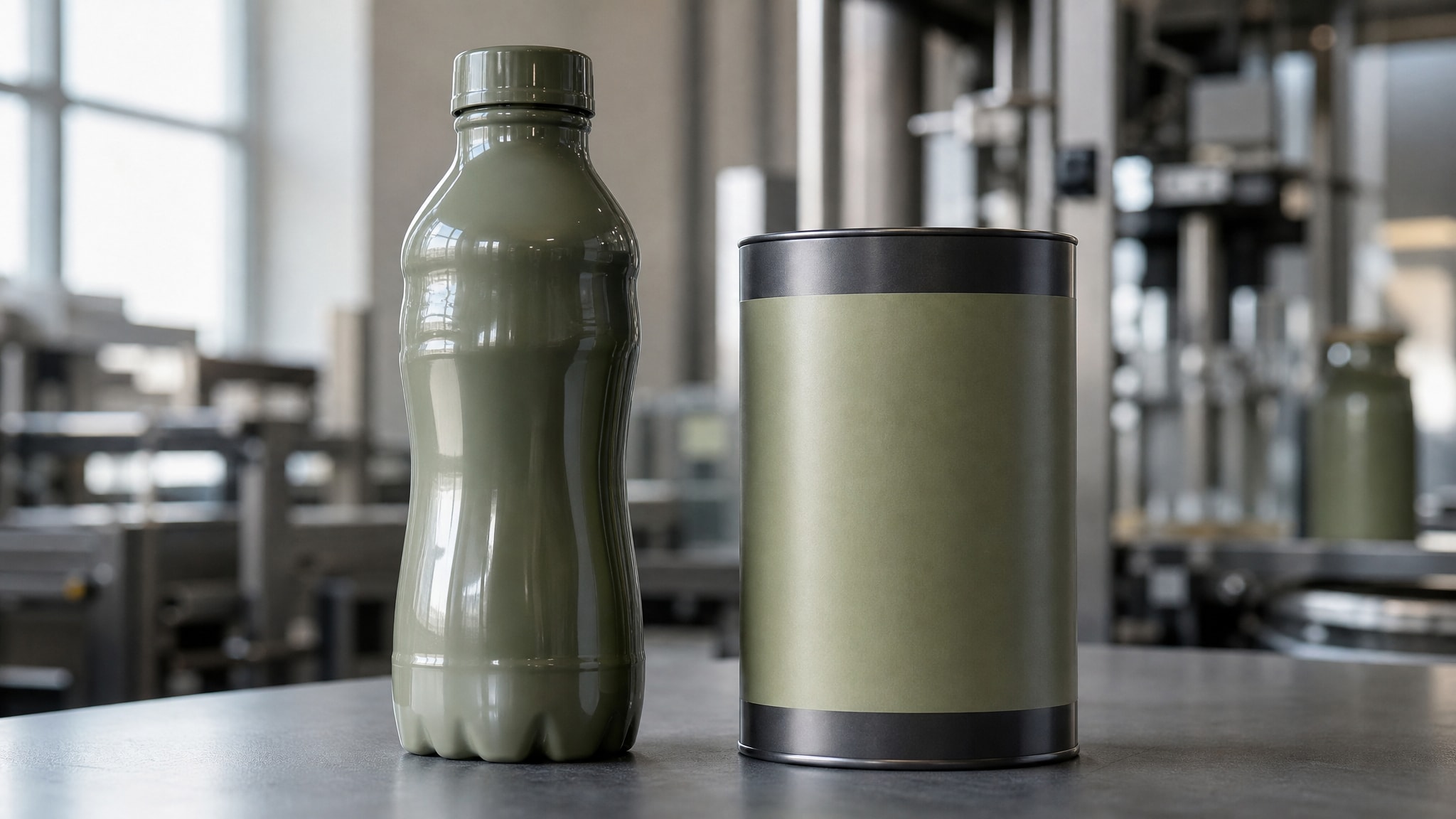
Complex curves, tapers and irregular contours need shrink sleeves for full 360-degree printing without wrinkling or distortion. Roll labels work best on cylindrical or flat surfaces with a consistent diameter, where adhesive contact stays uniform across the whole face stock. Misjudging container geometry is a leading cause of labelling defects and wasted stock, because adhesive simply cannot bridge a compound curve.
Gateway's packaging consultants routinely assess container geometry before recommending a format. Apply roll labels to a tapered bottle and you get flagging and rejection rates that exceed acceptable thresholds for an established FMCG brand. One personal care brand switched from roll labels to shrink sleeves for a curved shampoo bottle and eliminated 15% post-application waste that had been caused by edge lifting during transit and retail handling.
When your design needs uninterrupted graphics wrapping around corners or covering the neck-to-base transition, a partial roll label can't get the adhesion you need. If your container is a standard cylinder or jar with plenty of flat surface, a roll label gives you precise registration and faster changeovers, without the complexity of heat tunnel calibration.
Application Method and Production Line Compatibility
Shrink sleeves need dedicated heat tunnels and precise temperature control, so shrinkage is even and nothing scorches or seals incompletely. Roll labels integrate with the standard pressure-sensitive applicators common in local co-packing facilities, needing only web tension adjustment and sensor calibration for accurate placement. Your existing infrastructure often decides format viability more than unit cost alone, particularly when you're outsourcing to a contract packer with fixed equipment.
Line speed and changeover time frequently outweigh raw material savings once you calculate true production efficiency for a mid-volume run. If your facility has no sleeve application machinery, the capital outlay or third-party surcharge can wipe out any per-unit price advantage until volumes justify dedicated tooling. For runs between 2,000 and 50,000 units, the break-even point where shrink sleeves become cost-competitive with premium roll labels often hinges on whether the line already has heat tunnel infrastructure installed.
Roll labels allow rapid SKU changeovers with minimal downtime, which suits brands running multiple variants on shared lines. Sleeve applications need longer setup for tunnel profiling and film tracking, which rewards longer single-SKU runs but penalises frequent short batches.
Cost Per Unit and Budget Implications for SA Brands
Total landed cost covers material thickness, application energy, waste rates and minimum order quantities, not just the printed label price. Roll labels typically have lower entry costs, thanks to simpler substrates and wide applicator availability. Sleeves can still deliver better value per SKU when the shelf impact they create cuts what you'd otherwise spend on marketing. Understanding custom label printing costs in South Africa means looking at the whole conversion chain, not just the print quote.
Material yield differs between formats, because sleeves carry circumferential overlap and vertical trim waste that roll labels avoid entirely. But sleeves can remove the need for separate tamper-evident bands or decorative cartons in some categories, folding two packaging components into one. That consolidation can offset the higher per-label cost once you model total system savings against your current bill of materials.
Budget allocation should reflect strategic priorities, not default to the cheapest input. If premium positioning earns a margin uplift bigger than the extra packaging cost, the pricier format is the economically rational choice, whatever the unit spend looks like on its own.
Shelf Impact and Branding Opportunities by Format
Shrink sleeves give you edge-to-edge graphics and integrated tamper-evident seals, which read as premium through seamless visual continuity. Roll labels allow textured finishes and spot varnishes that convey tactile quality through substrate contrast and embossing, neither of which works on a heat-shrunk film. Research into how label design drives purchasing behaviour confirms that format choice influences purchase decisions at the point of sale, by signalling category cues and quality expectations.
You can use label finishes that enhance shelf presence differently depending on format. Metallic inks behave differently under heat shrinkage than under cold foil stamping on pressure-sensitive stock. Sleeves give you maximum canvas for storytelling and regulatory copy without crowding the front-panel hierarchy. Roll labels, by contrast, focus attention through negative space and material authenticity. The right choice fits your brand's visual language and the shelf you're competing on.
Consider how label material selection for cosmetics interacts with format constraints when you're developing a beauty or personal care range. Clear film sleeves create a no-label look that shows off product colour and texture. Opaque roll labels do the opposite: solid brand blocks that anchor shelf navigation in a crowded aisle.
Material Durability and Regulatory Compliance Factors
Shrink sleeves seal ink beneath film, which holds up better in wet environments, bathrooms, kitchens, industrial settings, where surface abrasion is constant. Roll labels rely on topcoats and laminates to protect printed content, and those can degrade with aggressive chemicals or prolonged moisture. Products headed for humid storage or repeated handling benefit from the barrier a sleeve builds in.
For pharmaceuticals and veterinary products, label integrity and legibility aren't negotiable, and that favours formats that resist delamination and chemical attack. Sleeves keep their grip even when a container is squeezed or deformed during dispensing, which prevents the edge lift that compromises barcode readability and patient safety information. Vinyl labels as an alternative roll format offer better chemical resistance for industrial use, though they still don't match the full encapsulation a shrunk film gives you.
Compliance documentation has to confirm the chosen material meets the relevant SANS standards for food contact, child resistance or hazardous substance labelling, whatever format you pick. Both technologies support variable data and serialisation, but sleeve distortion during shrinking needs careful artwork compensation to keep barcodes scannable once applied.
Selecting the Optimal Bottle Labelling Option for Your Product
No single format wins across every container, volume, budget and brand position. The right specification comes from weighing your own combination of these variables against production realities and market objectives, not from following generic industry advice. Gateway works as a consultative partner, assessing your specific product needs before recommending shrink sleeve label printing or roll label solutions, so packaging strategy and commercial outcome stay aligned.
Start by mapping your container geometry against the application infrastructure you already have, to find the technical constraints before you explore creative options. Then model total system costs, including any secondary packaging you could eliminate and the waste each format creates. Finally, check that your chosen option supports your brand's premium positioning and regulatory obligations for the life of the product.
Book a packaging consultation with Gateway to evaluate your specific container, volume and branding needs before committing to a label format. Our team gives evidence-based recommendations grounded in South African production experience, helping you avoid costly mis-specification and secure reliable supply for your next launch or range extension.
Frequently Asked Questions
What are shrink sleeve labels?
Shrink sleeve labels are printed polymer films applied loosely over a container then passed through a heat tunnel to contract tightly against the surface. They conform to complex shapes and provide 360-degree coverage without seams or visible adhesive edges.
What is the difference between a shrink label and a BOPP label?
BOPP labels are rigid biaxially oriented polypropylene films applied with adhesive to flat or cylindrical surfaces, offering excellent clarity and moisture resistance but no conformability. Shrink labels use heat-reactive films that mould to contoured containers, enabling full-body decoration and tamper evidence that BOPP cannot achieve.
Can roll labels be used on tapered bottles?
Roll labels generally fail on tapered bottles because the adhesive cannot maintain uniform contact across changing diameters, causing edge lifting or flagging during transport. Shrink sleeves are the appropriate format for tapered containers as thermal contraction ensures complete surface conformity without adhesive failure.
Which label format is cheaper for small production runs?
Roll labels typically have lower minimum order quantities and setup costs for runs under 5,000 units due to simpler application equipment and wider supplier availability. Shrink sleeves become cost-competitive at higher volumes or when they eliminate secondary packaging components like tamper bands or cartons.