Healthcare Packaging Supplier in SA: Choosing the Right Partner
Most packaging problems cost you a reprint. In healthcare, the same problem can cost you a batch, a customer's confidence or a conversation with your regulator. That changes what you should look for when choosing a packaging supplier for healthcare products in South Africa.
This guide is for brand owners, packaging managers and procurement teams at medical device, diagnostic and clinical consumable businesses. It covers who owns which part of compliance, what traceability a pack may need, which materials survive real use, and what evidence a supplier should give you before and after each run.
Why Healthcare Brands Need a Packaging Partner, Not Just a Printer
We use "healthcare products" here to mean medical devices, diagnostic kits and clinical consumables such as wound care products. These sit outside the pharmaceutical and veterinary work most packaging guides cover, but they carry many of the same pressures.
A label error weighs more in healthcare than in general FMCG work. A misprinted shampoo label is an embarrassing reprint. A wrong batch code, a missing symbol or an out-of-date instruction on a medical product can mean quarantined stock, a recall or a clinician working from the wrong information.
Consistency matters just as much. A hospital buyer or nurse expects the tenth delivery to look, read and scan exactly like the first, because a pack that looks different invites the question of whether the product is different.
That is why a healthcare brand needs a packaging partner, not just a printer. Gateway Print & Packaging takes responsibility for print execution: reproducing approved artwork exactly, controlling changes and keeping records. Your regulatory team owns the compliance decisions, including what the label must say.
Gateway's runs typically fall between 2,000 and 50,000 units for established brands, and healthcare is among the sectors it serves. The advice below therefore centres on repeat runs and approved artwork rather than one-off jobs.
What Makes a Compliant Healthcare Packaging Supplier
A compliant healthcare packaging supplier does not decide what is compliant. It makes sure that what you and your regulator have approved is what arrives on the pack, run after run, with a record to prove it.
Medical Device Labelling in South Africa: Who Owns What
The split is simple to state and easy to blur in practice. The brand owner, working within the requirements of the regulator, SAHPRA, sets the label content for medicines and medical devices. The supplier reproduces that content.
In practice, that means the supplier should:
- reproduce approved text, symbols and artwork exactly, without "improving" layouts or wording
- control every change, so that nothing moves between proof and press without written approval
- keep a written change record that links each version to the person who approved it
Language needs settling early. South Africa recognises 11 official languages, and translated copy is often longer than English. If your label must carry more than one language, confirm the requirement with your regulatory team before fixing the label size, or the text will not fit at a legible size.
No printer can promise regulatory approval of your label. Be wary of any supplier that implies it can.
Sterile Packs and Label Symbols: The Standards to Know
Two standards shape most healthcare packs. ISO 15223-1 sets out standard symbols for medical device labels, including "sterile", "do not re-use", "batch code" and "use-by date". Standard symbols help the same label read clearly across markets and languages, which matters when space on a small pack is tight.
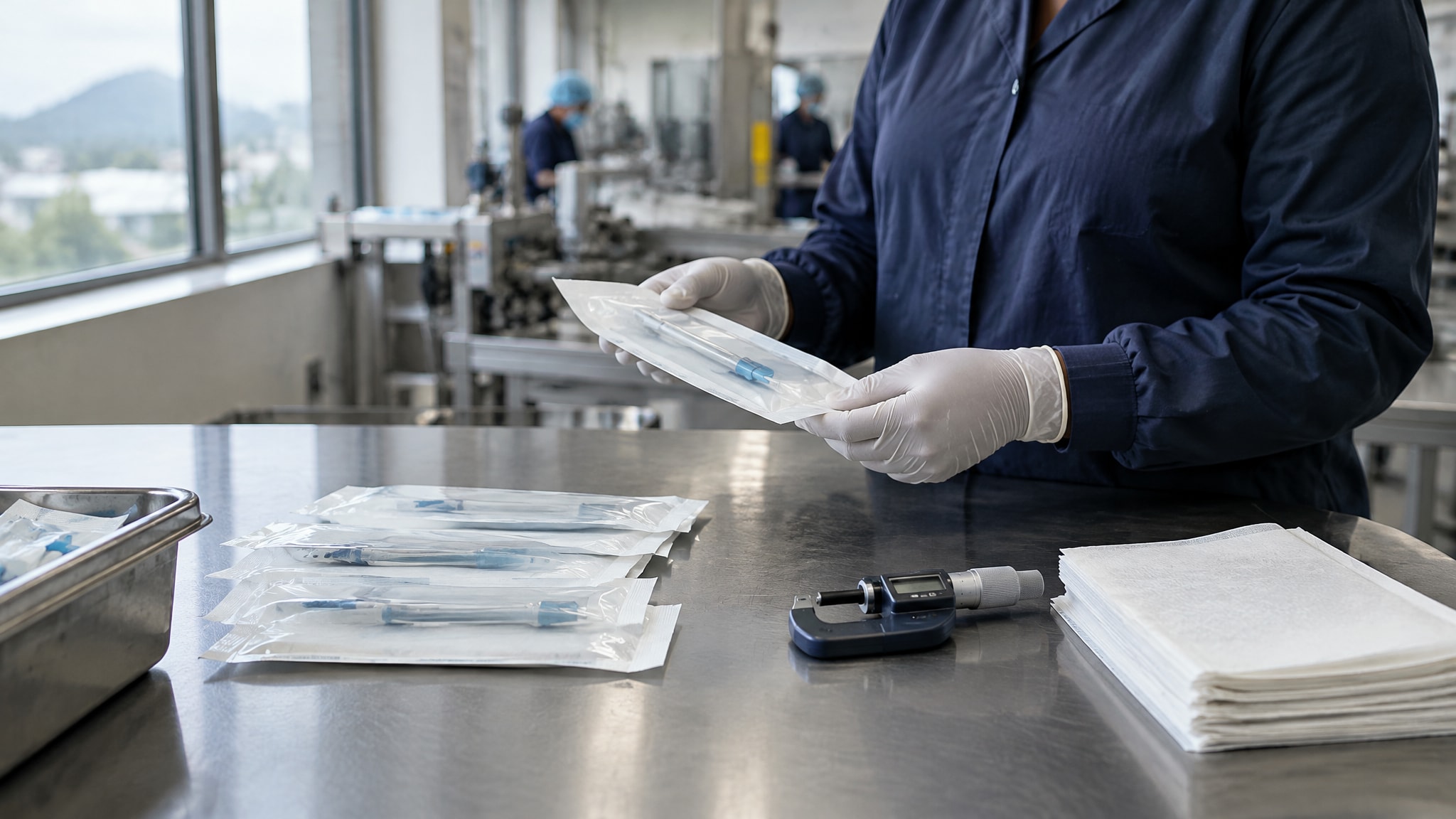
ISO 11607 covers packaging for terminally sterilised medical devices, including the sterile barrier and the validation of forming, sealing and assembly. Print and material specifications can affect seal performance, so they need to stay controlled from run to run, not just approved once.
If your product is sterilised in its pack, tell the supplier at the briefing stage. Your validation work then sets the material and print specification, and the supplier's job is to hold to it.
Traceability: Following Every Pack Back to Its Batch
When a hospital reports a problem, you need to trace the pack to its batch, and the batch to the artwork version printed on it. Traceability is partly what is printed on the pack and partly the paperwork behind it.
Gateway can tie each job to its approved artwork version through the job record. Ask any supplier you consider how its records do the same.
Batch, Expiry and Serial Coding That Stays Legible
Depending on the product, your pack may need a batch number, an expiry date and, where required, a serial number or a unique device identifier. Your regulatory team decides which apply and where they sit.
Variable data is usually applied by inkjet or thermal transfer, either on your pack line or as part of label production. Agree early who is responsible for it, because the answer affects label design, the space reserved for coding and the materials used.
Legibility is the practical test. Coding that smudges under a gloved thumb, or fades after alcohol wiping, defeats the purpose. Print sample codes on the actual material and test them before you commit to the run.
Barcodes That Scan at the First Attempt
A barcode that fails at a hospital goods-in desk reflects badly on the whole brand. Two-dimensional codes are graded against ISO/IEC 15415, which measures print quality rather than simply whether a scanner happened to read the code.
Most scanning failures are decided at design stage. GS1 identifiers must be correct, and the symbol must be large enough, with enough clear space around it, to scan reliably on the finished pack. A code squeezed into a corner to save space is a common cause of failure.
Export markets can also require serialised codes. That changes the label layout, so raise it before the artwork is drawn, not after.
Medical Product Label Printing: Choosing Materials That Hold Up
Medical product label printing is a materials question before it is a design question. A label that looks perfect off the press and peels after a week in a cold room has failed, however good the print.
Matching Label Materials to How the Product Is Used
Start with the conditions the label must survive. Depending on the product, these may include:
- repeated wiping with alcohol-based disinfectant
- moisture or condensation
- cold chain storage
- sterilisation, where it applies
Adhesion to the pack surface matters as much as the face stock. A premium film on the wrong adhesive will lift from a low-energy plastic or a curved pouch seal, so you need to consider the surface it sticks to, not only the label itself.
The practical way to choose is to test face material, ink, laminate and adhesive together, under your real conditions, on your real pack. Testing one component alone tells you very little about how the finished label behaves.
A few judgement calls come up often:
- Folding carton or label. For many boxed devices, kits and consumables, a printed folding carton carries the information more cleanly than a self-adhesive label, and removes the adhesion question altogether. A label suits a pack whose surface cannot be printed or that needs space for variable coding.
- Vinyl. Its durability costs more than a standard paper label. It is justified where the label faces regular wiping, moisture or handling for a long time, and not worth paying for on a pack that is opened once and discarded.
- Tamper evidence. If a sealed pack must show that it has been opened, build that into the label specification from the start. There is more detail in our look at tamper-evident options for sealed packs.
Gateway produces roll labels, vinyl labels and folding cartons, so it can advise on which format suits your pack. It cannot validate a material for your sterilisation process. That validation is yours to carry out.
Consistency and Quality Control Across Repeat Runs
Consistency is not an accident of good machines. It comes from approvals that happen before the run and checks that happen during and after it.
Proof Sign-Off and Colour Control
Mock-ups, artwork proofs and written sign-off are where most errors are caught cheaply. In a typical case, a proof shows a barcode sitting too close to a fold, or a symbol sized below the legible minimum. Fixing it at proof costs minutes. Fixing it after printing costs the run.
Written sign-off matters more than a verbal "looks fine". It creates a record of exactly what was approved, by whom, and when. Our article on how artwork errors turn into costly reprints shows where approval gaps usually open up.
Colour is held to an approved reference. For repeat runs, that means the supplier matches each reprint to the signed-off sample, not to someone's memory of the last job. If your range has several strengths, sizes or language versions, colour coding often tells users the products apart, so a drift in shade becomes a safety issue as well as a branding one. Our guide to keeping several product codes under control covers the version-control side.
Inspection, Sampling and Handling Rejects
Before you commit, ask what evidence comes with each delivery. A healthcare brand can reasonably expect:
- a stated sampling method for inspection
- batch records linking the run to approved artwork
- label reconciliation, so printed and used quantities account for every label
- a certificate of conformance, where your quality system requires one
- a documented route for rejects
Ask the supplier to confirm each of these in writing. A supplier that answers "we always check" without describing how is telling you something.
Rejects need a route as well. Defective labels should be identified, separated and destroyed or returned under a recorded process, so they never reach the wrong pack. For the process side, see the usual causes of packaging rejects.
Choosing a Healthcare Packaging Printer in South Africa
When you assess a healthcare packaging printer in South Africa, judge the system behind the print as much as the print itself. Use this checklist:
- Quality system. Look for a recognised standard such as ISO 9001. If you make devices, it also helps you meet your own ISO 13485 supplier controls, because you have documented processes to audit.
- Documentation. Ask for proof records, change records, batch records and conformance certificates, in the form your quality team needs.
- Lead times. Get them in writing, and ask what they assume. Lead times depend on proof sign-off, material availability and run size.
- Capacity. Confirm the supplier is comfortable with runs of roughly 2,000 to 50,000 units, not only much smaller or much larger work.
- Continuity. Ask whether reprints come from approved files, so run two matches run one.
- Location. A nearby partner makes proofing, sample checks and urgent queries easier. See choosing a local label printing partner for the trade-offs.
This process will not guarantee regulatory approval of your packaging. It will give you a supplier whose output you can document and defend.
Warning Signs in a Supplier Proposal
A very low quote deserves scrutiny, not celebration. If it leaves out proofs, sign-off or batch records, you have not saved money. You have moved the cost into rework, reprints and audit gaps, and you will pay it later. The real cost of choosing the cheapest printer explains how that happens.
Other signs to watch for:
- vague answers about how changes are controlled
- no written record of approvals
- promises of regulatory approval
- no willingness to describe inspection steps
Next Steps for Your Healthcare Packaging Project
A good healthcare packaging partner reproduces your approved copy exactly, controls change, documents each batch and tests materials against real use. Compliance decisions stay with you and your regulator. The supplier's job is to make sure those decisions reach the pack intact, every time.
If you are weighing options, send Gateway your approved copy, your current pack and your expected run size. We will tell you what we would check first. Lead times are confirmed at quoting stage, and regulatory approval remains with the brand owner.
To prepare first, read how to write a brief that gets an accurate quote.
Frequently asked questions
Who is responsible for compliance on a medical device label?
The brand owner is responsible, working within the requirements of the regulator, SAHPRA. Your regulatory team decides what the label must say. The printer's role is to reproduce the approved text exactly, control changes and keep a written record of them.
Can a printer guarantee that my packaging will be approved by SAHPRA?
No. Approval sits with the brand owner and the regulator, and no supplier can promise it. A supplier can make sure the approved artwork is printed accurately and that every change is recorded.
How do I test whether a label will survive disinfectant wiping?
Test the full label build together: face material, ink, laminate and adhesive. Apply it to your actual pack surface and expose it to the wiping, moisture or cold conditions it will meet in use. Testing one component on its own does not show how the finished label will behave.
Which documents should I ask a healthcare packaging supplier for?
Ask for signed artwork proofs, a written change record and batch records linked to the approved artwork version. Also ask for the sampling method used at inspection and a documented route for rejects. Ask the supplier to confirm in writing which of these it can provide.
What should I send a printer to get a useful first response?
Send your approved copy, your current pack and your expected run size. With those, a supplier can say what it would check first, such as barcode size, material suitability or label language space. A clear brief also helps the quote reflect the real job.